Leap Year Review


Introduction
Leap Year is a platformer game released on Steam in June of 2024 that was recommended to me by a good friend of mine. I'll attempt to break down the aspects of the game into individual categories and assign a score out of 100 based on certain entirely subjective criteria. The criteria I'll base my score on can be found here.
Spoiler warning
While I try my best to not spoil puzzle solutions or other major parts of the game, it is hard to write an in-depth review without doing so to some extent. If you have not played the game and do not wish to have aspects of the game revealed to you ahead of time, do not read this review.
Gameplay
The defining aspect of this game is the fact that literally nothing about it is explained to you as the player, you are intended to discover the innate abilities of your character by accidentally activating them. None of abilities are particularly difficult to find and understand but it will definitely require some exploring and backtracking to find areas where they may have been applicable previously.
I find that the way that Leap Year handles ability discovery is incredibly novel as compared to other Metroidvania / Puzzle Platformers I've played in the past. As opposed to finding unlocks as you progress, you start with every ability when you load into the game. As you manage to figure out what exactly each one does, it makes revisiting old locations with a new lens incredibly enjoyable. A great example of this is in the underground / dirt section early in the game, where there are puzzles that are technically immediately solvable the first time you enter the room, but you will realistically have to backtrack and solve on a 2nd visit once you discover how to activate the specific ability needed to unlock them.
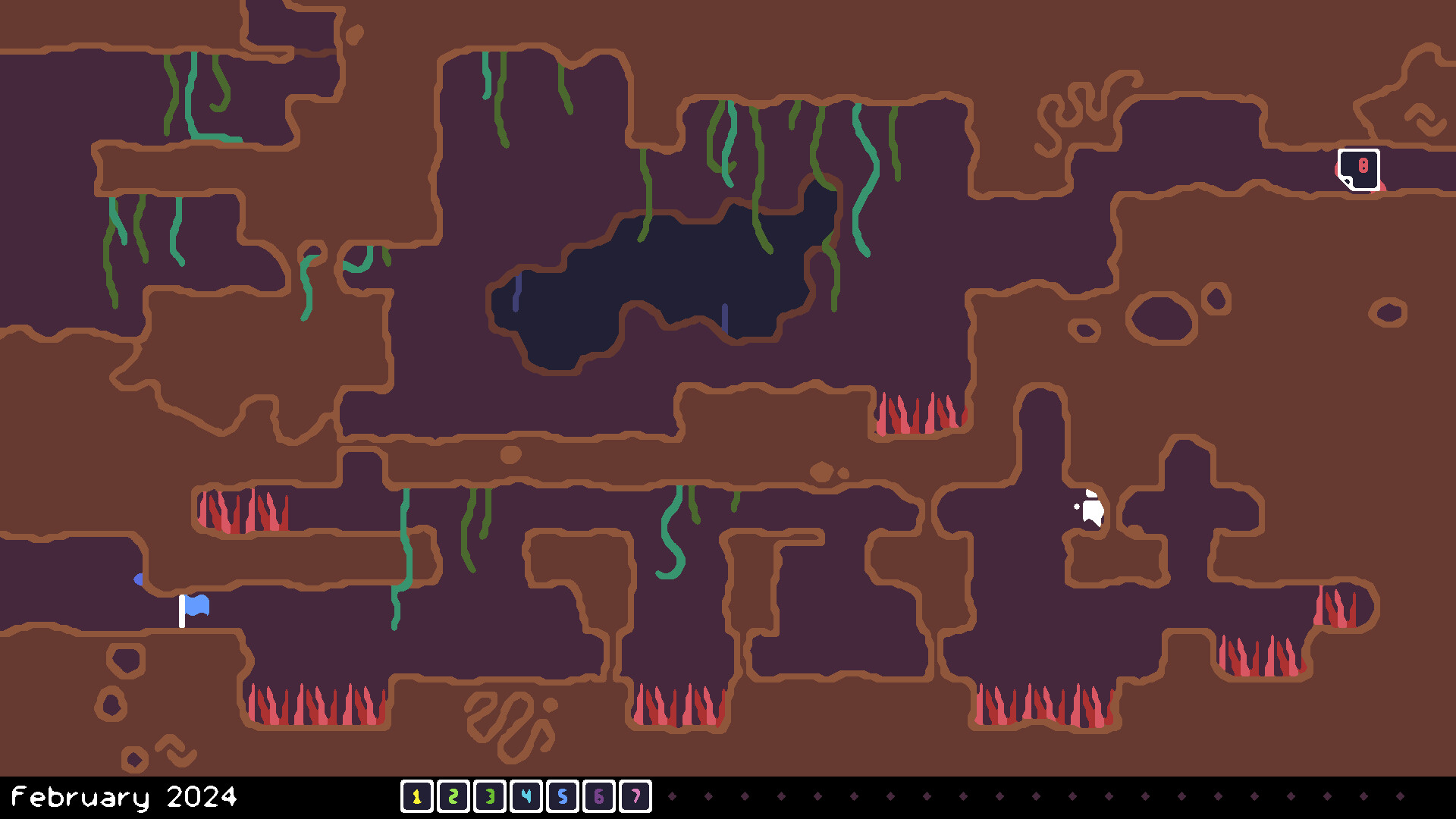
Overall, the gameplay loop is truly unique and makes it satisfying to explore the small world you're spawned into. While there are certainly some puzzles that are a bit harder than they probably should be for how far into the game you've made it, this is mostly a non-issue.
Gameplay Score: 17/20
Design
Leap Year's visuals are simple, yet charming. The hard drawn design of the levels give it a charming indie game vibe (which makes sense given as it was created by the talented indie developer Daniel Lenssen). There are only a select few rooms in the game (snow section I'm looking at you) that feel needlessly frustrating to explore and understand.

Every single aspect (and I really do mean every) of the level design feel intentionally placed. If you see something in the screen you're on that feels weird, there's probably something to be discovered there. Once you realize this, as the player, the game really feels like it begins to open up. You are able to use the level design as a guide, leading you quite naturally through some of the later game puzzles.
Design Score: 18/20
Music
The simplicity of the music in Leap Year fits the visual style very well. There are only a handful of tracks in the game's OST, though they never feel repetitive as they constantly shift as you move between the various biomes of the game. While the music isn't particularly impressive, it is certainly not something that makes the game less enjoyable.
Music Score: 7/10
Lore
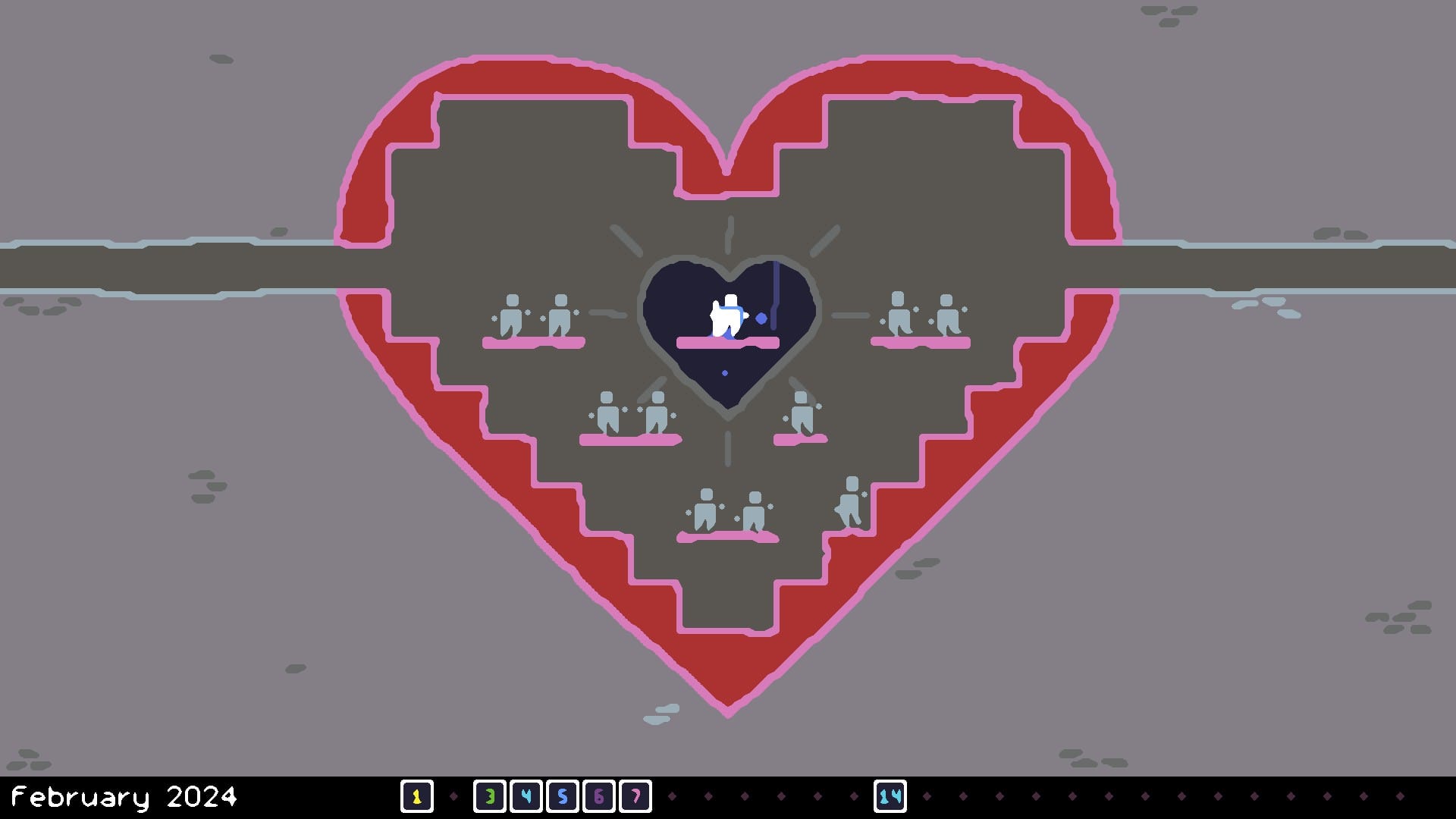
There's not much to talk about here unfortunately. There does not seem to be any discernible lore or overarching story in Leap Year. This does not feel unusual for a game of this style, but unfortunately I am unable to give it any points here as a result.
Lore Score: 0/10
Controls
NOTE: I played this game on keyboard controls, and the following is based on that.
Leap Year features an incredibly simple control scheme, you can move your character left & right, and you can jump. That's it. While incredibly simple at a glance, the nuance of using these simple controls and discovering the abilities that your character has makes for an incredibly rewarding experience. There were no points in the game where the controls themselves felt cumbersome, except for the final stretch of the game where your understanding of the controls is entirely turned on its head in order to make the final puzzle more challenging, though I found this to be a positive addition for the most part.
Control Score: 10/10
Difficulty
For the most part, the difficulty curve in Leap Year is both incredibly satisfying and sensical for the state of the game you find yourself in.
My only real gripe with the difficulty is the overall frustration felt in the final puzzle of the game. While I understand that it is meant to be the longest and most difficult puzzle, there were specific rooms that just feel needlessly complicated and were more a matter of brute forcing ideas as opposed to natural discovery. Overall though, the difficulty fits the game incredibly well.
Difficulty Score: 9/10
Overall Quality
The only thing that I'll harp on is the achievements in the game. Because I generally find myself wanting to 100% games of this nature due to their shorter length, I was a little disappointed to find that there were a handful of achievements that were locked behind a paid DLC to the game. While this is an entirely arbitrary stance to have, I feel like it did make it feel a little upsetting that I wouldn't be able to earn the "perfect game" stat on Steam without buying an additional DLC.

The achievement issue aside, Leap Year is an incredibly well made game. I encountered no bugs naturally throughout my playthrough and there was never a point during my playthrough where I felt that some aspect of the actual design hindered my enjoyment.
OQ Score: 18/20
Conclusion
Leap Year is a charming game that is well worth the 1-2 hours it will take the average player to complete. The various design elements compliment each other incredibly well and lead to a feeling of immense satisfaction when you finally finish it. At a staggeringly low $5.00 USD price point, it is well worth picking up for anyone who loves Metroidvania / Puzzle Platformer games.
Overall Score: 79/100
All images used in this article were sourced either from the Steam Store page or personal screenshots taken from the game.
Review #001